
Understanding Lung Cancer Risks for Nonsmokers
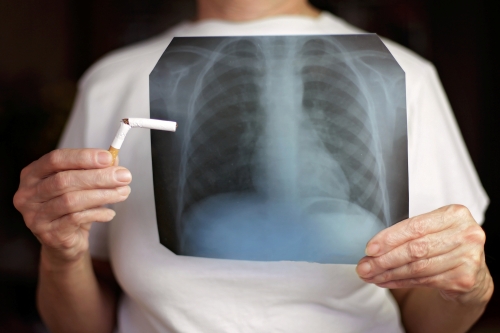 When Pope Leo XIV was diagnosed with lung cancer in October 2026, many people were surprised to learn the religious leader had never smoked. For decades, lung cancer has been linked so directly with smoking that the first question people ask after hearing about a diagnosis is often whether the patient smoked.
According to oncologist Laurie Carr, MD, this association has shaped not only how people think about lung cancer, but also how patients themselves are perceived. “Years ago, we used to say that there were no fun runs for lung cancer awareness,” said Dr. Carr. “There was a stigma attached to it, which is unfair, of course. Nobody deserves to get cancer. It was just that people would assume that if you smoked, you were bound to get it — and that lung cancer was exclusively a smoker’s disease. It’s only been recently that ‘never-smokers’ with lung cancer have challenged that assumption.”
While smoking remains the most important risk factor for lung cancer by far, it is not the only one. People who have never smoked can and do develop the disease, although Dr. Carr emphasizes that the overall risk for an individual “never-smoker” — generally defined as someone who has smoked fewer than 100 cigarettes over a lifetime — remains low.
Among people with non-small cell lung cancer, the most common broad category of lung cancer, about 15% are never-smokers. Small cell lung cancer, by contrast, is much more strongly associated with heavy smoking. “If cigarette smoking disappeared completely,” said Dr. Carr, “we’d definitely see substantially less lung cancer, but it wouldn’t disappear completely. There are other factors at play.”
Other Lung Cancer Risks
One of the best-established risks for people who do not smoke is long-term exposure to secondhand smoke. Dr. Carr emphasized that this means sustained exposure for years, such as growing up in a household where a parent smoked or living with a spouse who smoked regularly. The concern is not an occasional encounter with cigarette smoke, but repeated exposure that accumulates over a long period.
Radon is another important risk. The naturally occurring radioactive gas can enter homes from the soil and accumulate indoors, particularly in basements and other lower-level spaces. Radon is the second-leading cause of lung cancer after smoking, and it is especially relevant in Colorado, where elevated radon levels are common (see map of radon zones from the Environmental Protection Agency (Opens in a new window)). Increased cancer risk is associated with years of exposure, but testing a home can identify elevated levels and allow homeowners to take steps to reduce them.
Long-term occupational exposures can play a role as well. Dr. Carr pointed to asbestos as one example historically associated with increased lung cancer risk. Air pollution is another concern. Studies have found higher rates of lung cancer among never-smokers who live in urban areas with higher levels of air pollution.
Having a parent or sibling with lung cancer may increase a person’s chances of developing lung cancer, and researchers are beginning to identify genetic mutations that could help explain cases within families. Dr. Carr stressed, however, that the increase in risk from genetics is still far smaller than smoking.
In many cases, medicine sometimes cannot explain the precise reasons why a never-smoker develops lung cancer. This uncertainty can be particularly difficult for patients. Dr. Carr regularly treats people who have never smoked and said they often ask the same questions: “Why me? How did I get this? What did I do wrong?” Sometimes there is a recognizable risk factor, but in other cases there may be no clear answer.
Should Never-Smokers Be Screened for Lung Cancer?
For people with a significant smoking history, low-dose CT screening can help identify lung cancer before symptoms develop. Routine screening is generally reserved for people at sufficiently high risk, and, according to Dr. Carr, there is not currently enough evidence to show that most never-smokers benefit from annual lung cancer screening.
“We really don't have data saying that never smokers benefit from lung cancer screening because their overall risk is so low,” said Dr. Carr. In fact, according to the National Cancer Institute, (Opens in a new window) people who don’t smoke are 20 times less at risk for developing lung cancer than people who do.
There can be exceptions, particularly for people with other significant risk factors. If a person has an immediate family member who developed lung cancer, extensive secondhand smoke exposure or substantial occupational or environmental exposure, they can discuss that history with a health care provider and determine whether additional evaluation is appropriate.
Often, lung cancers in never-smokers are discovered by chance. A person may undergo imaging for abdominal pain, heart disease or another unrelated concern and have a portion of the lung included in the scan. Doctors may then notice a lung nodule (a small growth of dense tissue in the lung) that otherwise would not have been detected.
Moving Past the Stigma
People who have never smoked have played a significant role in changing public perceptions of lung cancer. “They've driven the issue forward,” said Dr. Carr. “Lung cancer patients need support. They need fundraising and excellent care, whether they have a history of smoking or not. It shouldn’t be about blame or stigma. And now we have foundations. We do have fun runs. It took a long time to get to this point.”
Dr. Carr stresses that reducing stigma should not obscure one of the most important facts about lung cancer prevention. “Lung cancer can affect anyone,” said Dr. Carr, “but you are significantly protected from risk if you stop smoking or especially if you never start in the first place.”
So, when it comes to understanding lung cancer, two messages should coexist. Smoking cessation remains one of the most powerful ways to reduce lung cancer risk, and people who develop the disease, whether they smoked or not, deserve care without judgment.